

Electroencephalography (EEG) is a non-invasive method for recording the electrical activity of the brain, which makes it possible to capture the summed electrical activity of large groups of neurons. The main advantage of EEG over other neuroimaging methods is its exceptionally high temporal resolution (down to milliseconds) and ease of use. This makes the technology indispensable both for the clinical diagnosis of neurological disorders and for scientific research into cognitive processes and brain functions.
The key component in EEG recording is the amplifier. It amplifies weak analog signals from the electrodes and converts them into a digital format for subsequent computer processing and storage.
MKS EEG amplifiers combine high performance and ease of use, successfully addressing a wide range of research and applied tasks.
Below are recommendations for selecting equipment for various EEG recording scenarios.
Laboratory/Research Solutions
For scientific and biomedical research, the company offers high-precision EEG amplifiers of the NVX series (72/136/272 channels). Thanks to their non-magnetic housing, the NVX models are compatible with MRI environments and can be placed directly in the scanner's working area.
Each amplifier channel is equipped with an individual 24-bit ADC, providing a signal sampling rate of up to 100,000 measurements per second. Experiment control and data recording are carried out in the NeoRec software. The software supports the standard EDF+, BDF+, and GDF formats, as well as the LSL (Lab Streaming Layer) protocol for synchronous operation with third-party packages, including MATLAB/EEGLAB and OpenViBE.
Clinical Application Solutions
For functional diagnostics tasks, MKS offers the NEUROvisor system. The solution is based on the time-tested NVX amplifiers (models 24/36/52), adapted for use in neurology departments, inpatient facilities, and diagnostic centers.
Key functionality:
-
Amplitude-frequency and spectral analysis of the main rhythms (including the construction of diagrams and maps);
-
Independent Component Analysis (ICA) for automatic artifact removal.
The NEUROvisor software has been developed specifically for clinical use. It is available for PCs and mobile devices and offers the physician convenient workflow scenarios:
-
A "one-button" mode for quick launch;
-
Standard montages and examination protocols compliant with IFCN recommendations;
-
Automated procedures with voice prompts to standardize examinations.
Universal Solutions
The NVX series amplifiers and their software have been developed as universal tools, equally effective in clinical practice and scientific experiments.
The Basic NVX 24/36/52 Line
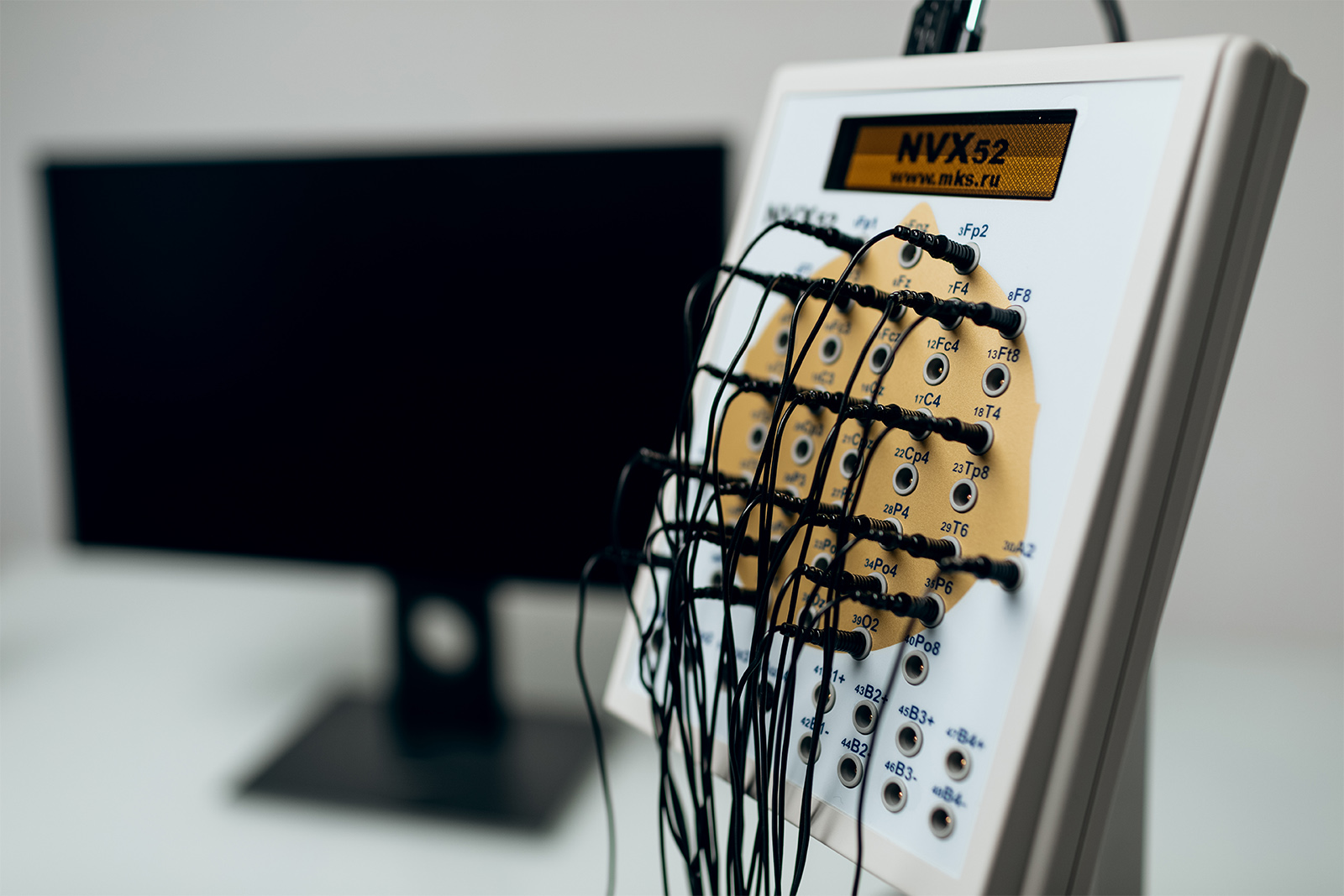
The NVX 24, NVX 36, and NVX 52 amplifiers are designed for short-term recording of EEG and other electrophysiological signals. The main difference between the models is the number of monopolar channels:
-
NVX 24: 24 channels;
-
NVX 36: 32 channels + 4 auxiliary bipolar channels (AUX) for NeoSens sensors;
-
NVX 52: 48 channels + 4 auxiliary bipolar channels (AUX) for NeoSens sensors.
Combined Solution: NVX-36T (EEG + tES)
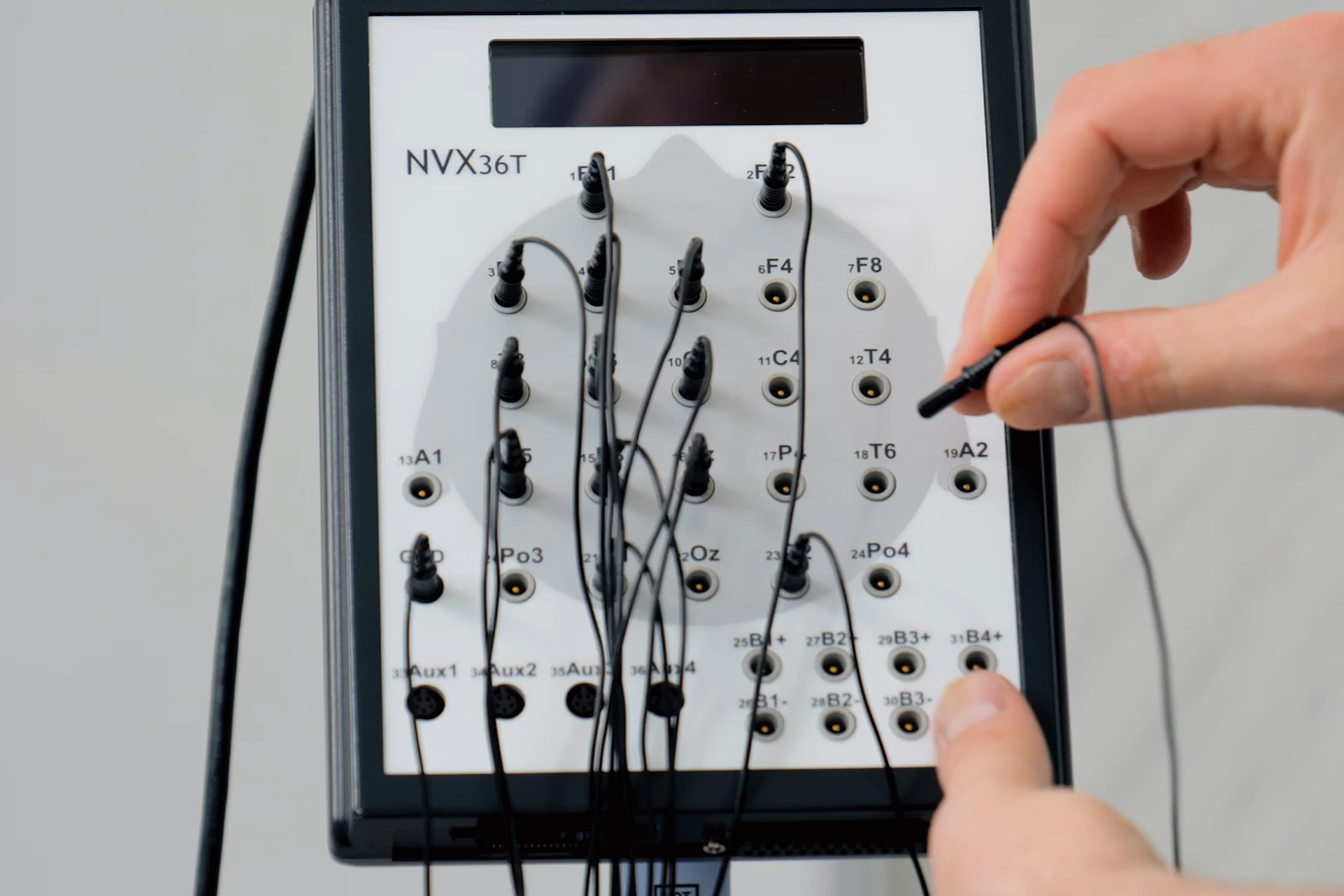
The NVX-36T model combines a 36-channel electroencephalograph (32 EEG + 4 AUX) and a transcranial electrical stimulator in a single housing.
The device operates under the control of the NeoRec research software and the specialized TETOS Expert software (for configuring stimulation protocols). Optional integration with the NEUROvisor system is available for clinical tasks.
Mobile and Wireless Solutions
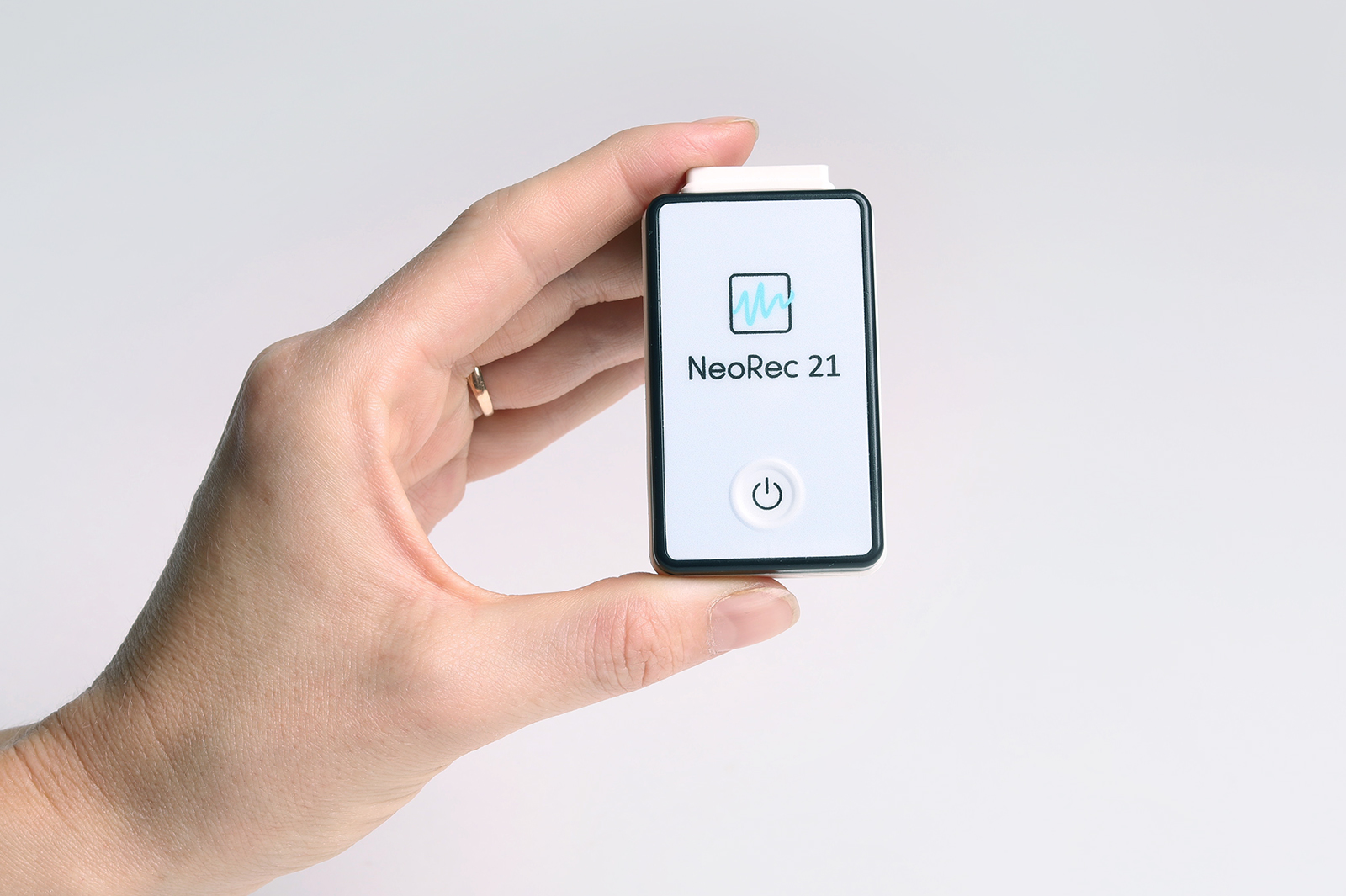
For tasks where compactness and freedom of movement are critical, MKS offers the NeoRec line of wireless EEG amplifiers (models 7, 21, and 21 mini).
The NeoRec 7 mini is an ultra-light 7-channel amplifier weighing only 14 grams, one of the smallest in the world. Thanks to its small dimensions, it can be used not only in human research but also in experiments on small laboratory animals (e.g., mice).
The NeoRec 21 and NeoRec 21 mini models are equipped with 21 EEG channels and an additional function for standalone recording to a built-in microSD card.
All devices in the line transmit data in real time via the Bluetooth Low Energy (BLE) protocol and are fully compatible with the MKS software ecosystem:
-
NeoRec research software;
-
NEUROvisor clinical software (including the mobile version).
Combined Use with Other Neuroimaging Methods
EEG-fMRI and EEG-MEG
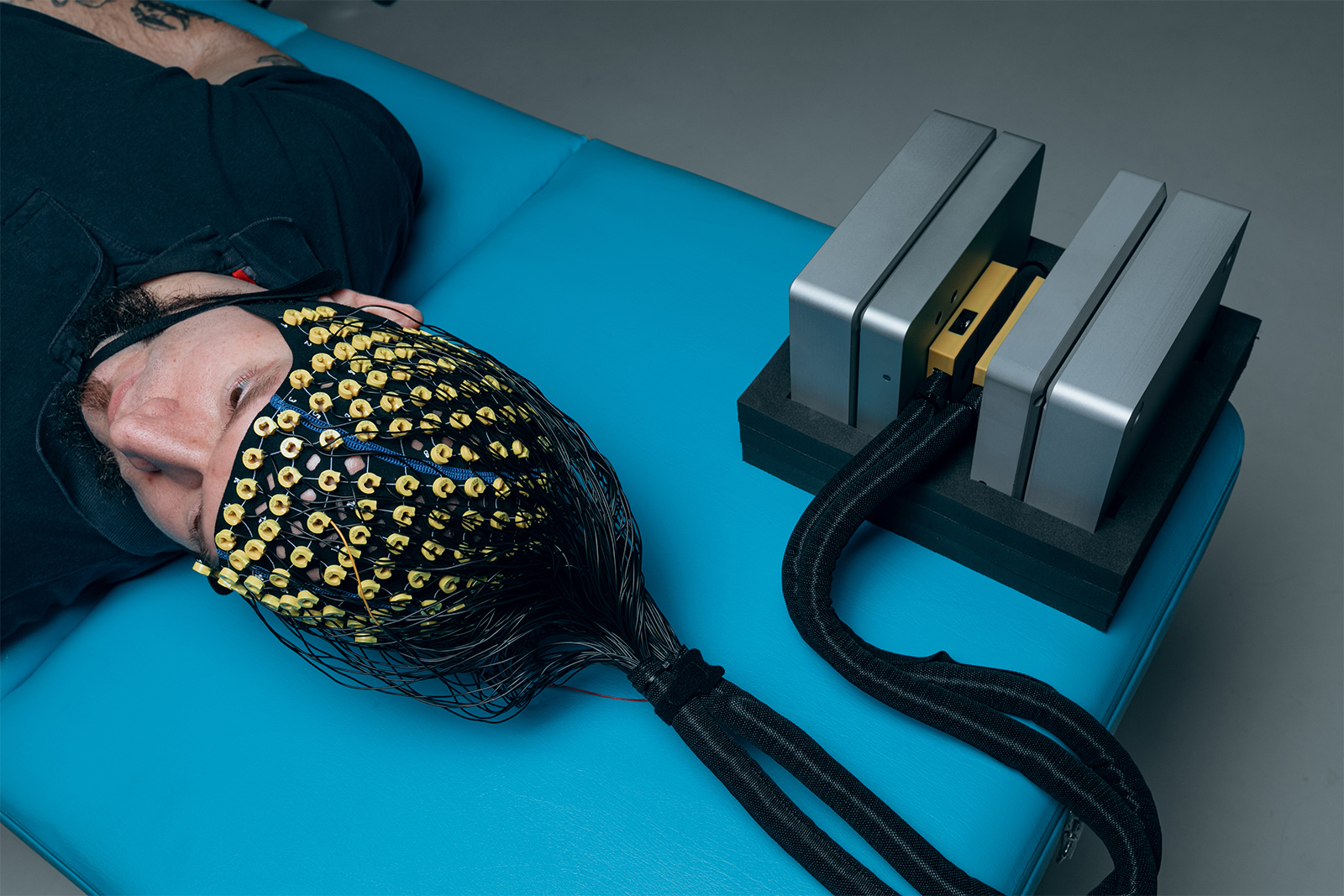
For combined EEG and functional MRI studies, MKS offers multichannel MR-compatible amplifiers of the NVX series (models 72/136/272). Thanks to the non-magnetic design of the housing, the amplifier can be placed directly in the scanner's working area, and the high sampling rate makes it possible to effectively suppress magnetic field artifacts.
Technical capabilities:
-
Input impedance greater than 1 GΩ for recording signals even through high-impedance electrodes.
-
Support for up to 272 channels, making the system optimal for high-density EEG.
-
Compatibility with magnetoencephalography (MEG) installations for conducting combined experiments.
EEG-TMS and EEG-tES
The NVX-36T amplifier is designed for combined research, combining EEG recording and transcranial electrical stimulation (tES). The device uses universal electrodes that work both in recording mode and in stimulation mode.
All major tES protocols are supported:
-
tDCS (direct current stimulation);
-
tACS (alternating current stimulation);
-
tRNS (random noise stimulation);
-
Sham stimulation (placebo control).
Multimodal Research (Polysomnography and Somnography, Sports Research)
NVX amplifiers make it possible to go beyond standard EEG through the integration of additional physiological signals. The NVX 36 and NVX 52 models are equipped with four galvanically isolated bipolar inputs (AUX) for connecting NeoSens sensors:
-
Photoplethysmography (PPG);
-
Respiratory thermal sensor;
-
Galvanic skin response (GSR);
-
3D accelerometer.
Ready-made solutions for applied tasks:
-
Somnography. Simultaneous recording of EEG, PPG, respiration, and GSR opens up possibilities for detailed analysis of sleep structure and the study of slow cortical potentials.
-
Sports research. The built-in 3D accelerometer makes it possible to synchronize neural activity with the subject's movements when studying brain function under conditions of physical exertion.
| Mobile DevicesNeoRec | Clinical / Laboratory DevicesNVX | MRI / High-Density EEGNVX-MR | |||||||||||||
| 7 mini | 21 | 21 mini | 24 | 36 | 36T | 52 | 72 | 136 | 272 | ||||||
| Technical Specifications | |||||||||||||||
| Sampling Rate | Sufficient (up to 1 kHz) | Sufficient (up to 1 kHz) | Sufficient (up to 1 kHz) | Excellent (up to 10 kHz) | Good (up to 5 kHz) | Sufficient (up to 2 kHz) | Good (up to 5 kHz) | Superior (up to 100 kHz) | Superior (up to 100 kHz) | Superior (up to 100 kHz) | |||||
| Maximum Number of Channels | Fixed (7) | Fixed (21) | Fixed (21) | Sufficient (24) | Sufficient (32) | Sufficient (32) | Sufficient (48) | Good (64) | Excellent (128) | Superior (256) | |||||
| Number of Sensor Channels | 0 | 0 | 0 | 0 | 4 | 4 | 4 | 8 mono / 4 diff | 8 mono / 4 diff | 8 mono / 4 diff | |||||
| Display | No | No | No | No | Yes | Yes | Yes | No | No | No | |||||
| Setup Complexity | Easy | Easy | Easy | Moderate | Moderate | Moderate | Moderate | Difficult | Difficult | Difficult | |||||
| Wireless Connection | Yes | Yes | Yes | No | No | No | No | No | No | No | |||||
| Standalone Real-Time Recording | microSD | LSL | LSL | LSL | LSL | LSL | LSL | LSL | LSL | LSL | |||||
| Compatibility in Research Scenarios | |||||||||||||||
| TMS/TES | Yes | Yes | Yes | Yes | Yes (recommended) | Yes | Yes (recommended) | Yes | Yes | Yes | |||||
| MEG | Yes | Yes | Yes | Yes | Yes (recommended) | Yes | Yes (recommended) | Yes | Yes | Yes | |||||
| MRI/fMRI | No | No | No | No | No | No | No | Yes | Yes | Yes | |||||
| Hyperscanning | Yes | Yes | Yes | Yes | Yes | Yes | Yes | Yes | Yes | Yes | |||||
| Supported Software | |||||||||||||||
| NeoRec | Yes | Yes | Yes | Yes | Yes | Yes | Yes | Yes | Yes | Yes | |||||
| NEUROvisor | Yes | Yes | Yes | Yes | Yes | Yes | Yes | Yes | Yes | Yes | |||||
| NEUROvisor mobile | Yes | Yes | Yes | No | No | No | No | No | No | No | |||||
Recommendations for selecting a model based on the scenario
| Scenario | Recommended Models |
| Clinical diagnostics | NVX 24 / 36 / 52 + NEUROvisor |
| Cognitive research in the laboratory | NVX 36 / 52 |
| High-density EEG | NVX 136 / 272 |
| EEG-fMRI | NVX 72 / 136 / 272 |
| EEG-MEG | NVX 72 / 136 / 272 |
| EEG-TMS | NVX 36 / 52, NVX-36T |
| EEG-tES | NVX-36T |
| Mobile research, sports | NeoRec 21 / 21 mini |
| Experiments on small animals | NeoRec 7 mini |
| Somnology | NVX 36 / 52 + NeoSens; NeoRec 21 |
| BCI and neurofeedback | NeoRec 21 / 21 mini |
| Hyperscanning | NVX 72 / 136 / 272; NeoRec 21 |
Our equipment
Important characteristics of EEG equipment
To correctly assess the quality of EEG equipment, it is important to understand the meaning of the following characteristics:
Sampling Rate
Shows how many signal measurements are made per second. According to the Nyquist theorem, the sampling rate must be at least twice the maximum frequency of the signal under study. For most neuroscience research, a value of 256 Hz is considered the minimum acceptable.
ADC Resolution / Bit Depth
Determines the accuracy of converting an analog signal into a digital code. Modern clinical and research amplifiers use ADCs with a resolution of 24 bits — this is the current quality standard.
Input Impedance
The resistance of the amplifier's input circuit. High input impedance (from 100 MΩ and above) is critically important for working with electrodes that have high resistance (e.g., dry or non-invasive electrodes). It prevents attenuation of the useful signal and distortion of the waveform.
Common Mode Rejection Ratio (CMRR)
The ability of the amplifier to ignore interference that is identical on both electrodes (e.g., pickup from the 50/60 Hz mains) and to amplify only the potential difference (the useful EEG signal). A CMRR of at least 80 dB at the mains interference frequency is considered acceptable.